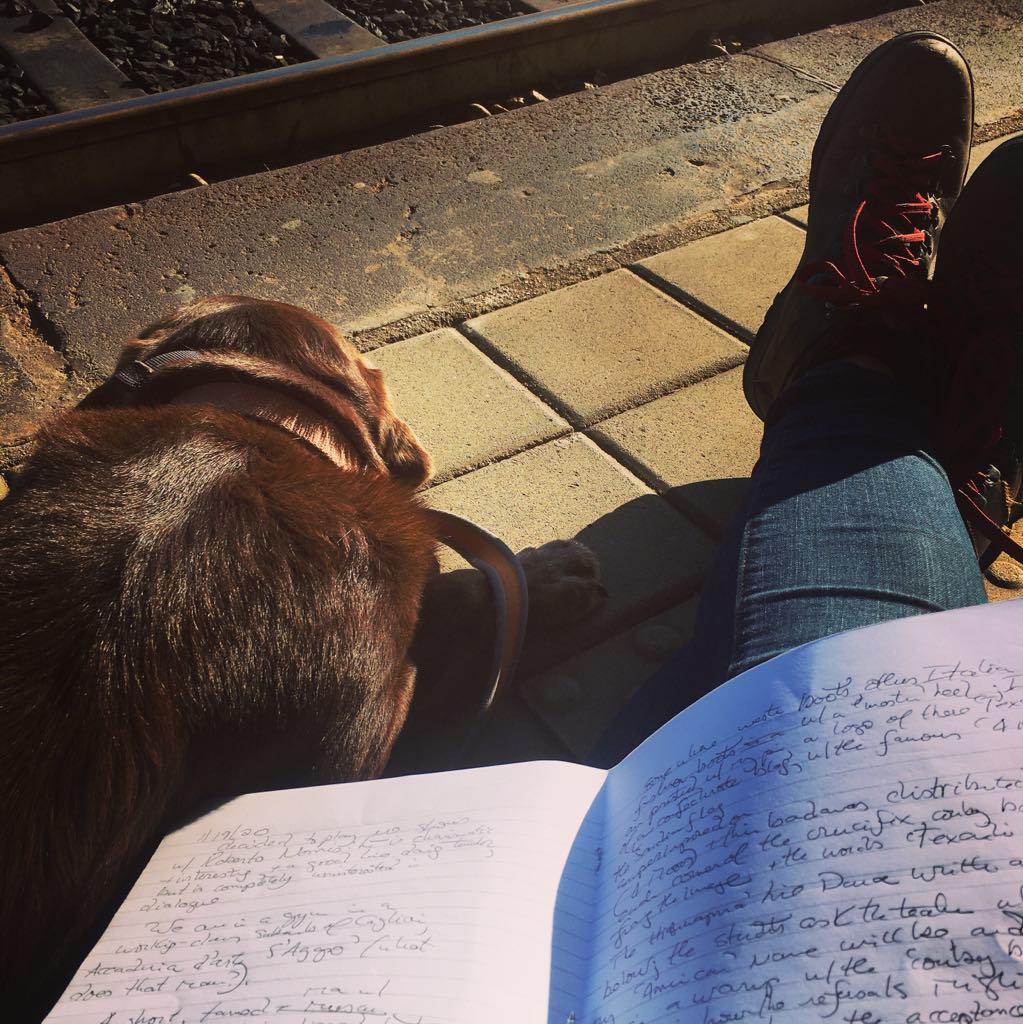
musings by the train tracks with dog, Oristano, Sardinia.
This past week has been rich and full, and I’ve been so busy studying, learning and trying to more actively speak in Sardu, there’s actually been very little time to write and reflect! I’ve also been busy planning music tours—a solo one I’ll do in northern Italy, and one with the band in Sardegna—will hope, in future posts, to have a chance to talk about the many ways the tours also interface with Sardinian language politics!
So here I am, back on the bandwagon. In the meantime, thank you to each of you—friends, family, colleagues and classmates—for your messages, emails and feedback on the pieces posted thus far—it’s been very inspiring/motivating to receive them, so please, keep them coming!
In an effort to peel back the curtain on my own language learning process—like mastering a cd, it often is presented as a sort of “black box,” in my experience—here is a daily look at what my language learning process is looking like:
Early a.m.: wake up, read over notes/new vocabulary from day before (classes, conversations, things
I’ve read) and record my voice reading these new words into my “recording” app on my phone
Take dog for walk, listening to these recordings through my headphones and repeating them, out
loud, as I walk down the main walking street in Cagliari (via Manno/via Garibaldi); return to apartment.
Mid-morning: exit my apartment and seek out language speaking situations (barista up in the Castello,
friends from my Campidanese class, phone conversations)
Early afternoon: do homework given to me by my teachers/work on more memorization
Late afternoon/early evening: attend one of my classes in Campidanese (the second one starts next week), or attend private language lesson in Santu Lussurgiu in the Lussorzesu version of Logudorese (technically a mix of Campidanese and Logudorese, called Arborense). All of these lessons are also recorded on my phone, for later playback.
In my lessons in this past week, and in order to have a more concrete sense of the distinction between the two principal variations of the Sardinian language, I’ve focused on learning a simple language introduction, for social and professional settings, but also for when I’m on stage in Sardegna, in both Logudorese and Campidanese. It’s been clarifying on a number of levels, for things from pronunciation (“s” versus “z”, for example) to word endings (“o” or “u”, for example), to intonation and phraseology. Overall, Campidanese, with its nasals and more open vowels, feels a little more comfortable for me and more colloquial overall; Logudorese, for me, takes a bit more effort and feels more controlled when I speak it. As my teacher of Logudorese would say, Logudorese is “sweeter” and a bit more “delicate” in the approach we need to use to speaking it.
So you can see the visual comparison (and also see how close both languages are to Latin and how much Spanish is also present!), here are the written introductions I’ve come up with in working with my teachers. As you’ll see, they are not exact carbon copies of one another—my vocabulary is limited enough that I can’t simply replace one word for another, just yet—but there are a number of similarities in the vocabulary used, so you can compare them against one another.
Campidanese:
Saludi totus. A mei mi nant Kristina. Bivo in Casteddu—Stampaxi—et Santu Lussurzu puru, peró seu nascia in Massachusetts e seu Americana. Seu una professora e imparu antropologia et etnomusicologia. A me mi praxit imparai su Sardu et is fuedus. Sonu sa chitarra e mi praxit a cantai; seu cantautora e seu cuntenta mera de essere qua [last two words are in Italian].
[English Translation: Hello to everyone. My name is Kristina. I live in Cagliari—in the neighborhood called Stampace—and also in the village of Santu Lussurgiu, but I was born in Massachusetts and I am American. I am a professor and I teach anthropology and ethnomusicology. I like learning the Sardinian language and other languages. I play the guitar and I like to sing; I’m a singer-songwriter and I’m very happy to be here with you].
Here is the recording to accompany the introduction, above:
Logudorese (meridionale):
Salude. Mi naro Kristina, e seo Americana. Bivo in Casteddu et in Santu Lussurzu. Imparo a sos istudentes antropologia et etnomusicologia. Mi agradat a imparare sa limba Sarda et sas limbas istranzas de tantos logos de su munnu. Seo naschida in Massachusetts, sono sa chitarra, e canto sas canzones inventadas de me.
[English translation: Hello. My name is Kristina, and I am American. I live in Cagliari and in Santu Lussurgiu. I teach anthropology and ethnomusicology to college students. I like learning the Sardinian language and foreign languages from all over the world. I was born in Massachusetts, I play the guitar, and I sing songs that were written by me.]
And here is the recording to accompany the introduction, above:
Last but not least—and the icing on the cake, as far as I’m concerned--here is a recording of my amazing language teacher from Santu Lussugriu reading the exact same text, above, as she gesticulates and mimes the words of the introduction to make it come alive (you can hear my laughing at her antics in the background). She is one of the most gregarious, generous and engaging human I know.
So: what do you all hear in each of these recordings, and what are the primary differences to your ears?
Challenges
Code-switching between one place (the village) and another (the city), and reminding myself which variant to use, where, has begun to be challenging. For example, the word for “much/a lot” (Italian=molto) is “meda” in Logudorese, and “mera” in Campidanese. I accidentally used “mera” during my lesson on Thursday in the village, which caused much laughter on the part of my teacher, who generously promised me she wouldn’t let the slip-up leave her house (i.e., she wouldn’t let anyone else in the village know I am learning Campidanese, since she knows it would sonically “mark” me). Another challenge I’m finding is the switch between the “seu” (I am) of Campidanese—open vowel on “e” sound, ends in a closed “u” sound, with the “s” sound more like a “z” in English—and the “seo” of Logudorese, which the “s” is softer and more sibilant, the “e” sound is closed not open, and the final vowel is an “o,” not a “u.”
Another challenge I’m having this week is finding the time every day to listen to hours and hours—in this case, between 6-8 hours each week—of recorded language classes and then writing down the additional vocabulary from these lessons. My modus operandi so far is lots and lots of dog walks—thank goodness my exquisite brown Labrador is here with me in Sardinia!—but, since my phone doesn’t get service in my subterranean apartment, this is also my phone call time with friends and loved ones, so it’s directly cut into that and I’m mindful of trying to keep a balance between the two. of course, I’m walking around in this beautiful city, and don’t want to always be the person with her headphones on, tuning the world out in order to tune into Sardinian! So, your best brain storming language learning tips are always welcome.
Other things you’ll see and hear:
After each verb ending in a “t” (indicates 3rd person singular), you’ll often hear an extra vowel added to the end of the word that’s not actually written. It’s always a repetition of the written vowel sound that came before—for example, “agradat” sound like “agradata”—and it seems to be always an unstressed vowel. This is called “paragogica,” and occurs consistently after verb conjugations ending in “t” and at the end of plural nouns ending in “s” (you hear it hear in the Logudorese recording in the word “estranzas,” so that it sounds like “estranzasa.” You’ll also hear the beautiful mellifluousness of my teacher’s voice, in contrast to my own more halting rendition.
Questions to ponder: to your ears, how different do these two versions sound to one another? Although most Sardinian speakers I know have the ability to speak one and at least understand the other, the ideologies of difference surrounding who speaks which are amazing different.
‘til the next time, and I’ll look forward to hearing from you.
And, below, are possible future posts, based on feedback I’ve received from readers thus far:
~learning languages in minoritarian language contexts: why do it, what do you get from it, and what is the motivation (Arrayan)
~Sardinian in urban language settings such as Cagliari and Sassari: what is the language reclamation scene like in the city, and what is the experience for Sardinians those learning Sardinian as a completely “foreign” language (Nike)
So here I am, back on the bandwagon. In the meantime, thank you to each of you—friends, family, colleagues and classmates—for your messages, emails and feedback on the pieces posted thus far—it’s been very inspiring/motivating to receive them, so please, keep them coming!
In an effort to peel back the curtain on my own language learning process—like mastering a cd, it often is presented as a sort of “black box,” in my experience—here is a daily look at what my language learning process is looking like:
Early a.m.: wake up, read over notes/new vocabulary from day before (classes, conversations, things
I’ve read) and record my voice reading these new words into my “recording” app on my phone
Take dog for walk, listening to these recordings through my headphones and repeating them, out
loud, as I walk down the main walking street in Cagliari (via Manno/via Garibaldi); return to apartment.
Mid-morning: exit my apartment and seek out language speaking situations (barista up in the Castello,
friends from my Campidanese class, phone conversations)
Early afternoon: do homework given to me by my teachers/work on more memorization
Late afternoon/early evening: attend one of my classes in Campidanese (the second one starts next week), or attend private language lesson in Santu Lussurgiu in the Lussorzesu version of Logudorese (technically a mix of Campidanese and Logudorese, called Arborense). All of these lessons are also recorded on my phone, for later playback.
In my lessons in this past week, and in order to have a more concrete sense of the distinction between the two principal variations of the Sardinian language, I’ve focused on learning a simple language introduction, for social and professional settings, but also for when I’m on stage in Sardegna, in both Logudorese and Campidanese. It’s been clarifying on a number of levels, for things from pronunciation (“s” versus “z”, for example) to word endings (“o” or “u”, for example), to intonation and phraseology. Overall, Campidanese, with its nasals and more open vowels, feels a little more comfortable for me and more colloquial overall; Logudorese, for me, takes a bit more effort and feels more controlled when I speak it. As my teacher of Logudorese would say, Logudorese is “sweeter” and a bit more “delicate” in the approach we need to use to speaking it.
So you can see the visual comparison (and also see how close both languages are to Latin and how much Spanish is also present!), here are the written introductions I’ve come up with in working with my teachers. As you’ll see, they are not exact carbon copies of one another—my vocabulary is limited enough that I can’t simply replace one word for another, just yet—but there are a number of similarities in the vocabulary used, so you can compare them against one another.
Campidanese:
Saludi totus. A mei mi nant Kristina. Bivo in Casteddu—Stampaxi—et Santu Lussurzu puru, peró seu nascia in Massachusetts e seu Americana. Seu una professora e imparu antropologia et etnomusicologia. A me mi praxit imparai su Sardu et is fuedus. Sonu sa chitarra e mi praxit a cantai; seu cantautora e seu cuntenta mera de essere qua [last two words are in Italian].
[English Translation: Hello to everyone. My name is Kristina. I live in Cagliari—in the neighborhood called Stampace—and also in the village of Santu Lussurgiu, but I was born in Massachusetts and I am American. I am a professor and I teach anthropology and ethnomusicology. I like learning the Sardinian language and other languages. I play the guitar and I like to sing; I’m a singer-songwriter and I’m very happy to be here with you].
Here is the recording to accompany the introduction, above:
Logudorese (meridionale):
Salude. Mi naro Kristina, e seo Americana. Bivo in Casteddu et in Santu Lussurzu. Imparo a sos istudentes antropologia et etnomusicologia. Mi agradat a imparare sa limba Sarda et sas limbas istranzas de tantos logos de su munnu. Seo naschida in Massachusetts, sono sa chitarra, e canto sas canzones inventadas de me.
[English translation: Hello. My name is Kristina, and I am American. I live in Cagliari and in Santu Lussurgiu. I teach anthropology and ethnomusicology to college students. I like learning the Sardinian language and foreign languages from all over the world. I was born in Massachusetts, I play the guitar, and I sing songs that were written by me.]
And here is the recording to accompany the introduction, above:
Last but not least—and the icing on the cake, as far as I’m concerned--here is a recording of my amazing language teacher from Santu Lussugriu reading the exact same text, above, as she gesticulates and mimes the words of the introduction to make it come alive (you can hear my laughing at her antics in the background). She is one of the most gregarious, generous and engaging human I know.
So: what do you all hear in each of these recordings, and what are the primary differences to your ears?
Challenges
Code-switching between one place (the village) and another (the city), and reminding myself which variant to use, where, has begun to be challenging. For example, the word for “much/a lot” (Italian=molto) is “meda” in Logudorese, and “mera” in Campidanese. I accidentally used “mera” during my lesson on Thursday in the village, which caused much laughter on the part of my teacher, who generously promised me she wouldn’t let the slip-up leave her house (i.e., she wouldn’t let anyone else in the village know I am learning Campidanese, since she knows it would sonically “mark” me). Another challenge I’m finding is the switch between the “seu” (I am) of Campidanese—open vowel on “e” sound, ends in a closed “u” sound, with the “s” sound more like a “z” in English—and the “seo” of Logudorese, which the “s” is softer and more sibilant, the “e” sound is closed not open, and the final vowel is an “o,” not a “u.”
Another challenge I’m having this week is finding the time every day to listen to hours and hours—in this case, between 6-8 hours each week—of recorded language classes and then writing down the additional vocabulary from these lessons. My modus operandi so far is lots and lots of dog walks—thank goodness my exquisite brown Labrador is here with me in Sardinia!—but, since my phone doesn’t get service in my subterranean apartment, this is also my phone call time with friends and loved ones, so it’s directly cut into that and I’m mindful of trying to keep a balance between the two. of course, I’m walking around in this beautiful city, and don’t want to always be the person with her headphones on, tuning the world out in order to tune into Sardinian! So, your best brain storming language learning tips are always welcome.
Other things you’ll see and hear:
After each verb ending in a “t” (indicates 3rd person singular), you’ll often hear an extra vowel added to the end of the word that’s not actually written. It’s always a repetition of the written vowel sound that came before—for example, “agradat” sound like “agradata”—and it seems to be always an unstressed vowel. This is called “paragogica,” and occurs consistently after verb conjugations ending in “t” and at the end of plural nouns ending in “s” (you hear it hear in the Logudorese recording in the word “estranzas,” so that it sounds like “estranzasa.” You’ll also hear the beautiful mellifluousness of my teacher’s voice, in contrast to my own more halting rendition.
Questions to ponder: to your ears, how different do these two versions sound to one another? Although most Sardinian speakers I know have the ability to speak one and at least understand the other, the ideologies of difference surrounding who speaks which are amazing different.
‘til the next time, and I’ll look forward to hearing from you.
And, below, are possible future posts, based on feedback I’ve received from readers thus far:
~learning languages in minoritarian language contexts: why do it, what do you get from it, and what is the motivation (Arrayan)
~Sardinian in urban language settings such as Cagliari and Sassari: what is the language reclamation scene like in the city, and what is the experience for Sardinians those learning Sardinian as a completely “foreign” language (Nike)
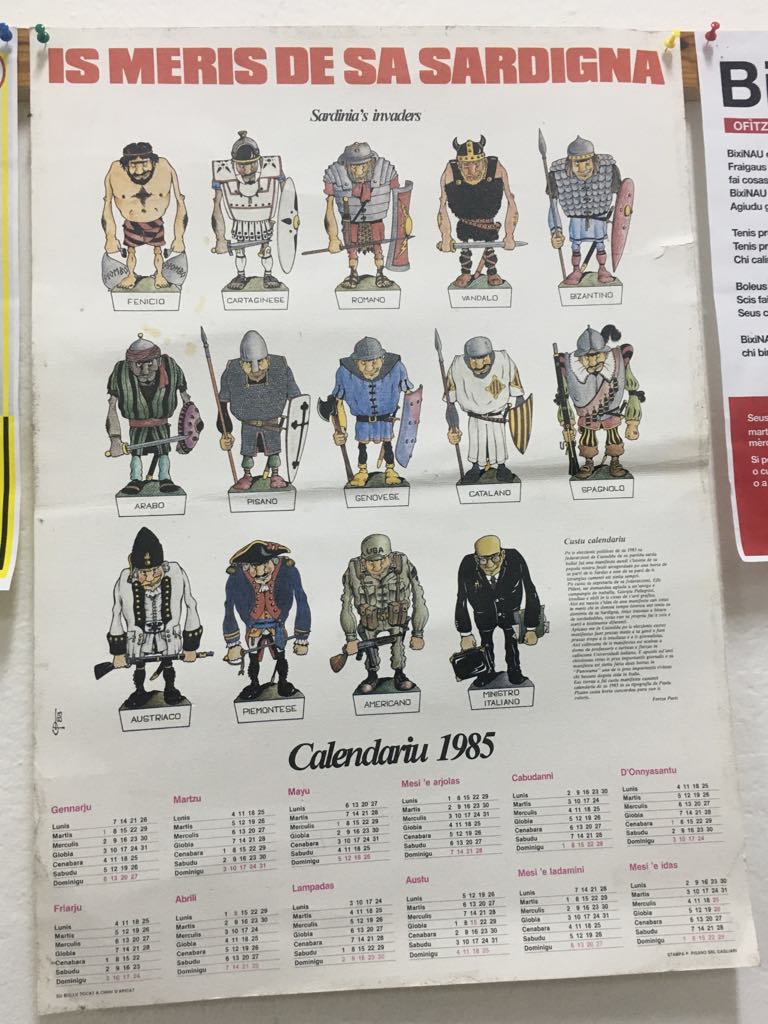
Colonizers of Sardinia. Calendar written in Campidanese, documenting Sardinia's history of multiple occupations (note American military personnel, second to last in the line up).
 RSS Feed
